

Electrical & Renewable Energy
Inverter or battery backup: what is the difference?
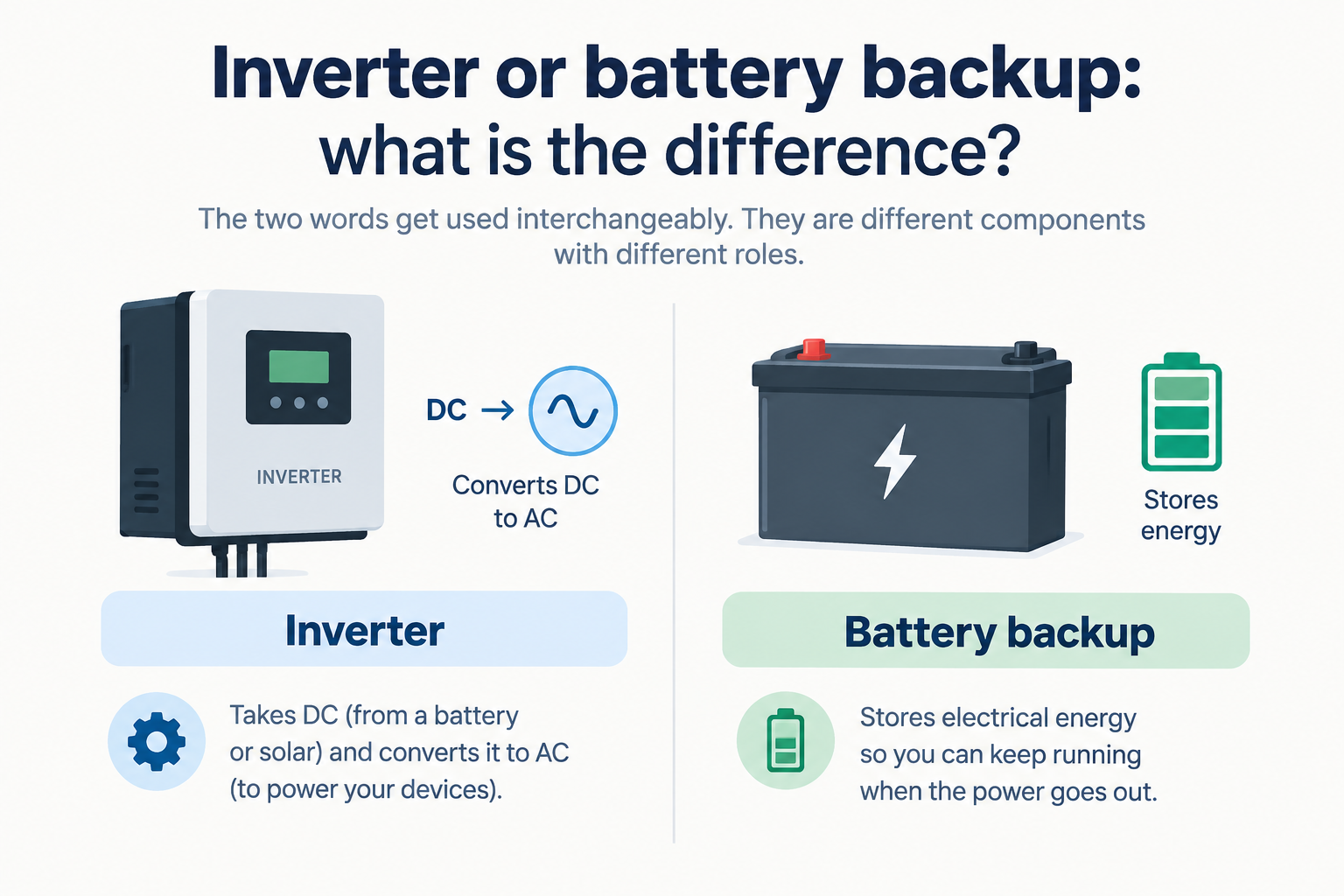
The two words get used interchangeably. They are different components with different jobs, and confusing them leads to undersized systems.
2 Aug 2026
2 min read
Vermont Group Limited
An inverter and a battery are not alternatives to each other — they are two parts of the same system, and each is sized on a different number.
The inverter sizes your power
The inverter converts stored direct current into the alternating current your equipment uses. Its rating, in kVA or kW, determines how much you can run at once. If everything you might switch on simultaneously totals 6 kW, a 3 kVA inverter will trip regardless of how many batteries sit behind it.
The battery sizes your time
The battery bank determines how long you can run. Capacity, in kilowatt-hours, divided by your load gives your runtime. Doubling battery capacity does not let you run more equipment at once; it lets you run the same equipment for longer.
Why lithium changed the arithmetic
Lead-acid banks should not be discharged much past half their capacity without shortening life sharply, so a nominal 10 kWh bank realistically gives about 5 kWh. Lithium (LiFePO4) can be discharged much deeper and cycles far more times, which usually makes it cheaper per usable kilowatt-hour over the life of the system even though it costs more up front.
The practical check
Ask two questions of any quotation: what is the continuous and surge rating of the inverter, and what is the usable — not nominal — capacity of the battery bank. If a supplier cannot answer both clearly, the system has not been sized.
Need this specified and quoted?
Send us your requirement and we will come back with equipment options, lead times and pricing.
Related reading